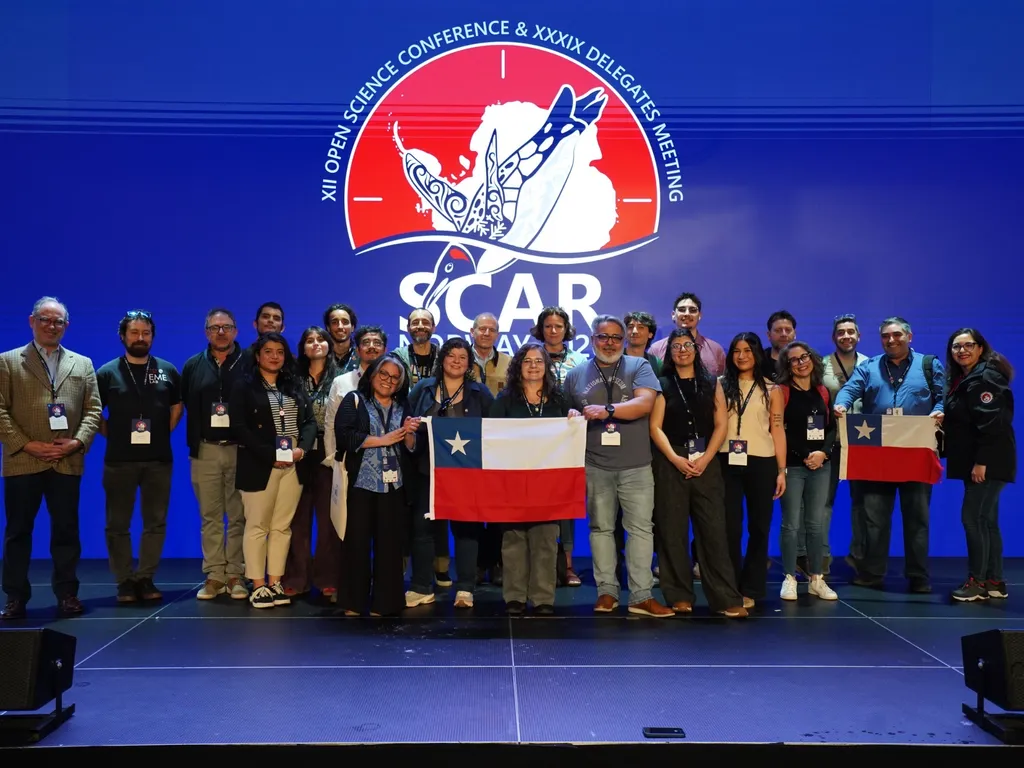
The national delegation, led by the Chilean Antarctic Institute, along with countless male and female researchers, in the 12th SCAR Open Science Conference (SCAR), held from August 8 to 14, 2026, in Oslo, Norway, under the motto “Diving into Antarctic Science: Making Waves for the Future”.
The team of Chilean researchers and diplomats—backed by Chilean Ambassador Helmut Lagos—presented crucial advances in areas such as glaciology, climate change, and the conservation of polar biodiversity. In addition, research in social sciences, scientific outreach, and humanities was presented, as well as studies focused on polar history, heritage, governance, and the relationship of human beings with this extreme environment.
Gino Casassa Rogazinski, director of INACH, pointed out that “we celebrate the remarkable presence of our country at the SCAR Open Science Conference in Norway. In the book of abstracts of this major international science meeting, there are 127 papers with an author affiliated with Chile, of which 66 have a first author affiliated with Chile.”.
Dr. Elie Poulin, director of the BASE Millennium Institute, added that “these figures reflect very well the significant presence that Chile had at SCAR OSC 2026. Furthermore, it was an excellent opportunity for the Chilean Antarctic community to meet in Oslo. Without a doubt, the quantity and diversity of national contributions at this conference show the level of development and international visibility of Antarctic science conducted from Chile. Likewise, as the BASE Millennium Institute, we want to be an actor that supports INACH in the upcoming International Polar Year, which will be of utmost relevance,» emphasized the University of Chile academic.
Similarly, various activities related to polar research and its connection to decision-making were carried out, such as the mini-symposium “Terrestrial Invasions in Antarctica: Emerging Threats, Adaptive Mechanisms, and Governance Challenges”, organized and coordinated, among others, by Dr. Hugo Benítez from the Millennium Institute BASE.
For his part, Dr. Marcelo Leppe, paleobiologist and former director of INACH, stepped down from the SCAR vice presidency after four years. “It was a profound privilege to work alongside colleagues from the most diverse corners of the world, united by a single purpose: to materialize the vision of the largest scientific organization in the Antarctic Treaty ecosystem—collaborative, equitable, and quality science that advises the Treaty's various subsidiary groups and seeks to deepen the understanding of the importance of protecting the White Continent,” he added.
Likewise, at this international event, the SCAR medals were presented. Prof. Peter Convey (British Antarctic Survey, United Kingdom) received the Medal for Excellence in Antarctic Research, Dr. Renuka Badhe (EuroGOOS) was awarded the Medal for International Scientific Coordination, and Prof. Silvia Dotta (Federal University of ABC, Brazil) received the Education and Communication Medal.
INACH is a technical organization of the Ministry of Foreign Affairs with full autonomy in all matters related to Antarctic affairs of a scientific, technological, and outreach nature. INACH complies with the National Antarctic Policy by encouraging the development of excellence in research, effectively participating in the Antarctic Treaty System and related forums, strengthening Magallanes as a gateway to the White Continent, and carrying out actions to disseminate Antarctic knowledge to the public. INACH organizes the National Antarctic Science Program (PROCIEN).
Source: INACH