The Memory of the Climate | Evidence of Climate Change.
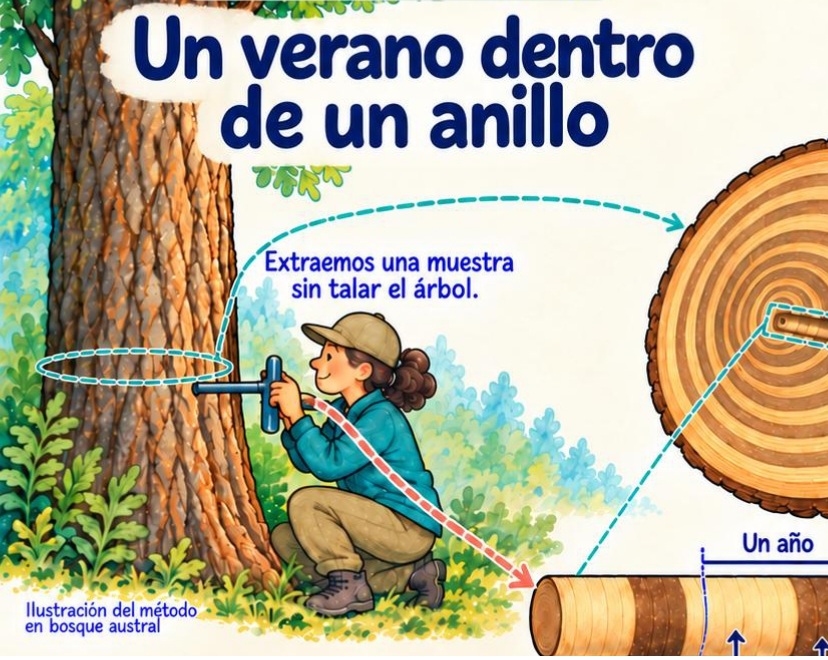
Trees hold clues in their growth rings. They usually form one ring per year, and the wood changes depending on what that year was like. In very cold places, a warm summer usually results in a wider ring and denser wood. In dry places, on the other hand, rainfall is usually the main factor that shapes the ring.
Jan Esper, Max Torbenson, and Ulf Büntgen compared tree-ring data with thermometer readings. They found that the summer of 2023 was the warmest in the past 2,000 years in the Northern Hemisphere outside the tropics.
Did you know that…?
- Don't cut down the tree: Using a hand drill, you can remove a wooden dowel about as thick as a pencil, and the hole is so small that the tree suffers no lasting damage.
- Width isn't the only clue: Each growth ring consists of earlywood and latewood, the latter of which is denser. In cold regions, warmer summers tend to make the latewood even denser.
- The rings can be joined together: When comparing living trees with old wood, the growth rings fit together like a puzzle. In Central Europe, this method was used to construct a 12,460-year-long record.
- In Chile, we have a massive archive: On a southern Chilean larch stump, 3,622 growth rings were counted—that is, more than 3,600 years of history!!
- Volcanoes also leave their mark: The coldest summer on record was in the year 536, marked by a volcanic eruption. The summer of 2023 was nearly 4 °C warmer.
📖 Article: “2023 Summer Heat Unparalleled in the Past 2,000 Years.”.
✍️ Authors: Jan Esper, Max Torbenson, and Ulf Büntgen.
📚 Nature | 2024.
🔗 DOI: https://doi.org/10.1038/s41586-024-07512-y
📖 Article: “Interannual Variability in Conifer Tree-Ring Density—Anatomical, Physiological, and Environmental Determinants.”.
✍️ Author: Cyrille B. K. Rathgeber.
📚 New Phytologist | 2017.
🔗 DOI: https://doi.org/10.1111/nph.14763
📖 Article: “Ecological and climatological signals in tree-ring width and density chronologies along a latitudinal boreal transect.”.
✍️ Authors: Elisabeth Düthorn, Lea Schneider, Björn Günther, Simon Gläser, and Jan Esper.
📚 Scandinavian Journal of Forest Research | 2016.
🔗 DOI: https://doi.org/10.1080/02827581.2016.1181201
📖 Article: “The 12,460-Year Hohenheim Oak and Pine Tree-Ring Chronology from Central Europe—A Unique Annual Record for Radiocarbon Calibration and Paleoenvironmental Reconstructions.”.
✍️ Authors: Michael Friedrich, Sabine Remmele, Bernd Kromer, Jutta Hofmann, Marcus Spurk, Klaus Felix Kaiser, Christian Orcel, and Manfred Küppers.
📚 Radiocarbon | 2004.
🔗 DOI: https://doi.org/10.1017/S003382220003304X
📖 Article: “A 3,620-year temperature record from Fitzroya cupressoides "Tree rings in southern South America.".
✍️ Authors: Antonio Lara and Ricardo Villalba.
📚 Science | 1993.
🔗 DOI: https://doi.org/10.1126/science.260.5111.1104
📖 Resource: “Sampling Trees Using an Increment Borer.”.
✍️ Author: U.S. Geological Survey (USGS).
📚 USGS | 2023.
🔗 Link: https://www.usgs.gov/media/images/sampling-trees-using-increment-borer