The Memory of the Climate | Evidence of Climate Change.
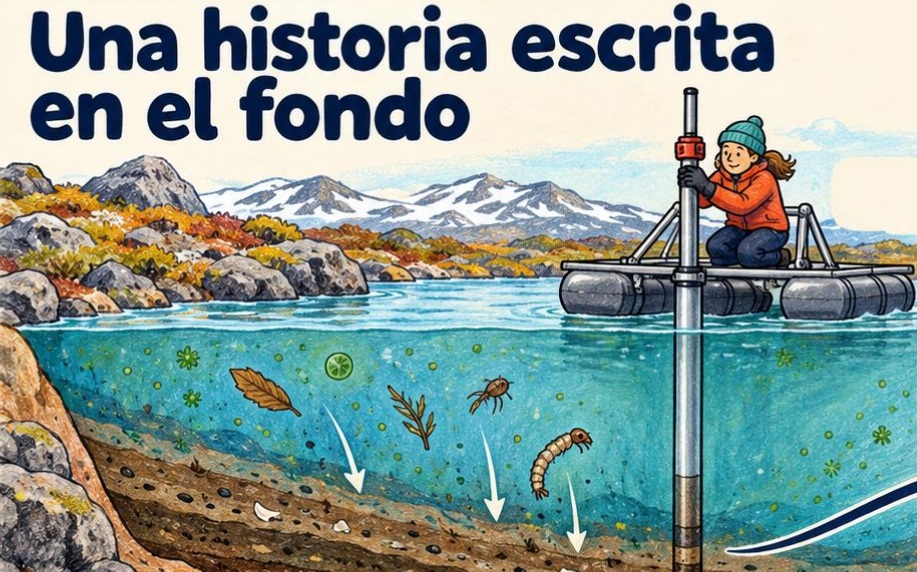
Year after year, mud, remains of living things, and chemical signals accumulate at the bottom of the lakes. This forms layers that preserve clues about each era. When we extract them and calculate their age, we can reconstruct how the lake and its climate changed.
A team studied Lake CF8, on the island of Baffin in the Canadian Arctic. Its sediments preserve warm periods from the last 200,000 years. The recent changes in its aquatic insects, microscopic algae, and water chemistry are unmatched in those periods, and reveal a transformation associated with the warming associated with increased human activity after 1950.
Did you know…?
- This lake survived the glaciers: The ice covered it several times, but it hardly eroded it. That's why its old mud is still there.
- It is a very old file for the Arctic: Its record is about 80,000 years older than Greenland's oldest intact ice core.
- There are insects that can tell the weather: In the mud, remains of small insects are found when they die. The species that prefer cold began to decrease abruptly around 1950.
- The algae also leave clues: The diatoms are microscopic algae that are preserved in the sediment. A species that was previously uncommon in CF8 increased strongly in the last decades in response to warming.
- In Chile we also read about lakes: A 11-meter-long witness of Lake Puyehue holds about 17,900 years of history. Its most recent layers even show signs similar to those of El Niño.
📖 Artículo: “Recent changes in a remote Arctic lake are unique within the past 200,000 years”.
✍️ Authors: Yarrow Axford, Jason P. Briner, Colin A. Cooke, Donna R. Francis, Neal Michelutti, Gifford H. Miller, John P. Smol, Elizabeth K. Thomas, Cheryl R. Wilson and Alexander P. Wolfe.
📚 PNAS | 2009.
🔗 DOI: https://doi.org/10.1073/pnas.0907094106
📖 Article: “A 17,900-year multi-proxy lacustrine record of Lago Puyehue (Chilean Lake District): introduction”.
✍️ Authors: Marc De Batist, Nathalie Fagel, Marie-France Loutre and Emmanuel Chapron.
📚 Journal of Paleolimnology | 2008.
🔗 DOI: https://doi.org/10.1007/s10933-007-9113-2