The Memory of the Climate | Evidence of Climate Change.
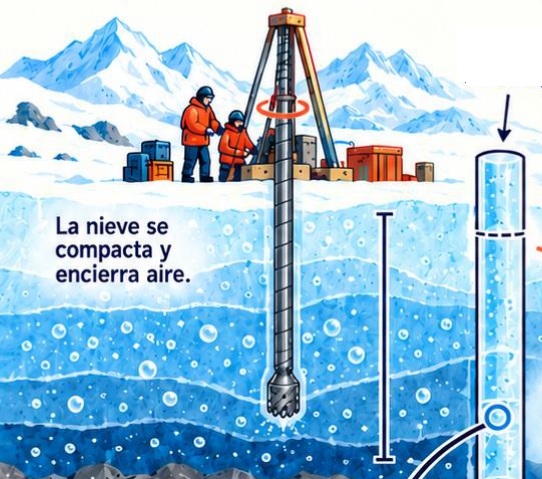
In Antarctica, the snow accumulates year after year and turns into ice, trapping small samples of air in its bubbles. The deeper the ice is, the older it is, so if we know how much snow accumulates in a year as ice, we can estimate the age of the deep ice. By analyzing those trapped bubbles, we can discover how much carbon dioxide (CO₂) was in the atmosphere at that time.
By searching for these increasingly deep bubbles, the study by Lüthi and colleagues extracted a long cylinder of ice (called a “testimony”) from the depths of Antarctica at a site called “Dome C.” Thanks to it, they were able to learn about the CO₂ in the atmosphere 800,000 years ago, and not only that, but its change over time.
Did you know…?
- The ice witness is enormous: The European project EPICA drilled more than 3 km into Dome-C, until it was just a few meters from the rock.
- One meter of ice can keep centuries: Near the surface, a meter holds about 35 years of history. Near the bottom, the weight of the ice compresses the layers so much that a meter holds about 1,000 years.
- Hundreds of bubbles can fit in a cube: A 1 cm-thick piece of ice on one side can contain hundreds. In the deepest areas, the pressure turns them into crystals that continue to hold the air.
- Volcanos help calculate the age: Their eruptions leave marks in the ice that act as marks on a time scale.
- Just a little bit is enough to travel to the past: To measure the oldest CO₂ samples were used samples of about 8 grams, slightly larger than a die.
📖 Article: “High-resolution carbon dioxide concentration record 650,000–800,000 years before present”.
✍️ Authors: Dieter Lüthi, Martine Le Floch, Bernhard Bereiter, Thomas Blunier, Jean-Marc Barnola, Urs Siegenthaler, Dominique Raynaud, Jean Jouzel, Hubertus Fischer, Kenji Kawamura and Thomas F. Stocker.
📚 Nature | 2008.
🔗 DOI: https://doi.org/10.1038/nature06949
📖 Article: “Global Carbon Budget 2025”.
✍️ Authors: Pierre Friedlingstein and collaborators.
📚 Earth System Science Data | 2026.
🔗 DOI: https://doi.org/10.5194/essd-18-3211-2026
Ice stores air from the past. Studying it helps us understand the present.